Let me be honest with you about something that took me years to figure out: the way most of us were taught to study is completely broken and it's not your fault.
You sit in a classroom for six hours. A teacher reads from slides. You copy notes. You go home, read those notes back to yourself, maybe highlight a few things, and then if you're a "good student" you do it again the night before the exam. Sound familiar?
Here's what nobody tells you: that method doesn't actually build knowledge. It builds the feeling of knowledge. And on exam day, those two things are very different.
This article is about why the traditional approach fails Cambridge IGCSE and A-Level students specifically, what the research says about how people actually learn, and why a platform like Leminno was built to solve the exact problems the classroom can't.
The Fundamental Problem: Schools Are Built for Teaching, Not for Learning
There's an important distinction between teaching and learning that the education system quietly ignores.
Teaching is what happens when a teacher delivers information. Learning is what happens when a student retains and can use that information. The two don't automatically go together and in a classroom of 30 students, they often don't.
A Cambridge IGCSE teacher has a syllabus to cover, a timetable to stick to, and dozens of students at different levels. If half the class understands osmosis and the other half doesn't, the lesson still moves on. The students who didn't quite get it are now trying to understand active transport while still confused about the previous topic. That gap compounds. By the time Paper 4 rolls around, the confusion is five layers deep.
"The problem isn't the students. It's a system that was never designed to adapt to individual learning pace."
This isn't a criticism of teachers most of them are doing an extraordinary job under real constraints. It's a structural problem. The classroom, as it was designed in the industrial era, was optimised for delivering content to many people at once. It was never optimised for ensuring that each individual actually learned.
The Memorisation Trap
Ask a student what their revision looks like and most will say some version of: re-read the textbook, copy out notes, make flashcards, and read those too.
The problem? Every one of those activities is passive. You're consuming information, not producing it. And the exam doesn't ask you to consume it asks you to produce: write, explain, apply, evaluate.
Cognitive scientists call this the "fluency illusion." When you re-read something that's already familiar, your brain registers it as "known." But recognition and recall are completely different skills. Recognition is seeing a word and knowing you've heard it. Recall is being able to produce that word in a blank exam paper with no hints.
Traditional education is overwhelmingly built around recognition. The exam tests recall. That mismatch is why students who studied really hard still walk out of the hall feeling like they knew nothing.
The fix isn't studying more. It's studying differently specifically, using active recall and immediate feedback loops rather than passive re-reading. This is something a traditional classroom structurally cannot offer. A platform like Leminno's practice bank can, because it makes every single study session an active retrieval exercise.
One-Size-Fits-All Is a Myth
Here's something every student knows but rarely says out loud: the speed of a classroom is almost never right for you personally. It's either too fast or too slow rarely just right.
If the class moves too fast, you fall behind and feel stupid. If it moves too slow, you zone out and fall behind for a different reason. Either way, the outcome is the same: gaps in understanding that nobody helps you fill.
Adaptive learning systems are the antidote to this. Rather than moving at the pace of a curriculum calendar, a platform like Leminno moves at the pace of your actual performance. Answer a topic's questions well and the system knows to move on. Keep getting a particular concept wrong and it keeps serving you variations of that concept not because it's punishing you, but because your answers told it exactly where your brain needs more work.
This is what a one-to-one tutor would do if you could afford a hundred hours with one. Leminno makes it available to anyone with an internet connection.
What "Everything in One Place" Actually Means for Your Scores
One of the underrated reasons students underperform is simply friction. Getting ready to study involves finding the right textbook, finding the right chapter, finding past papers in a different place, finding mark schemes somewhere else, trying to figure out which topics you're weak on by memory alone and by the time all of that is sorted, it's 45 minutes later and motivation has dissolved.
Leminno was built to eliminate that friction. Here's what's in one place:
Structured lessons: syllabus-aligned notes written to match exactly what Cambridge examiners expect, not textbook padding. You open a topic, you read what matters, you move on.
Unlimited practice questions: you can do as many as you want, any time. There's no "you've run out of exercises." The practice bank is always there.
Instant mistake review: every wrong answer is immediately flagged and explained. You don't have to wait for a teacher to mark a paper and hand it back three days later. You know what you got wrong right now, while the thinking is still fresh.
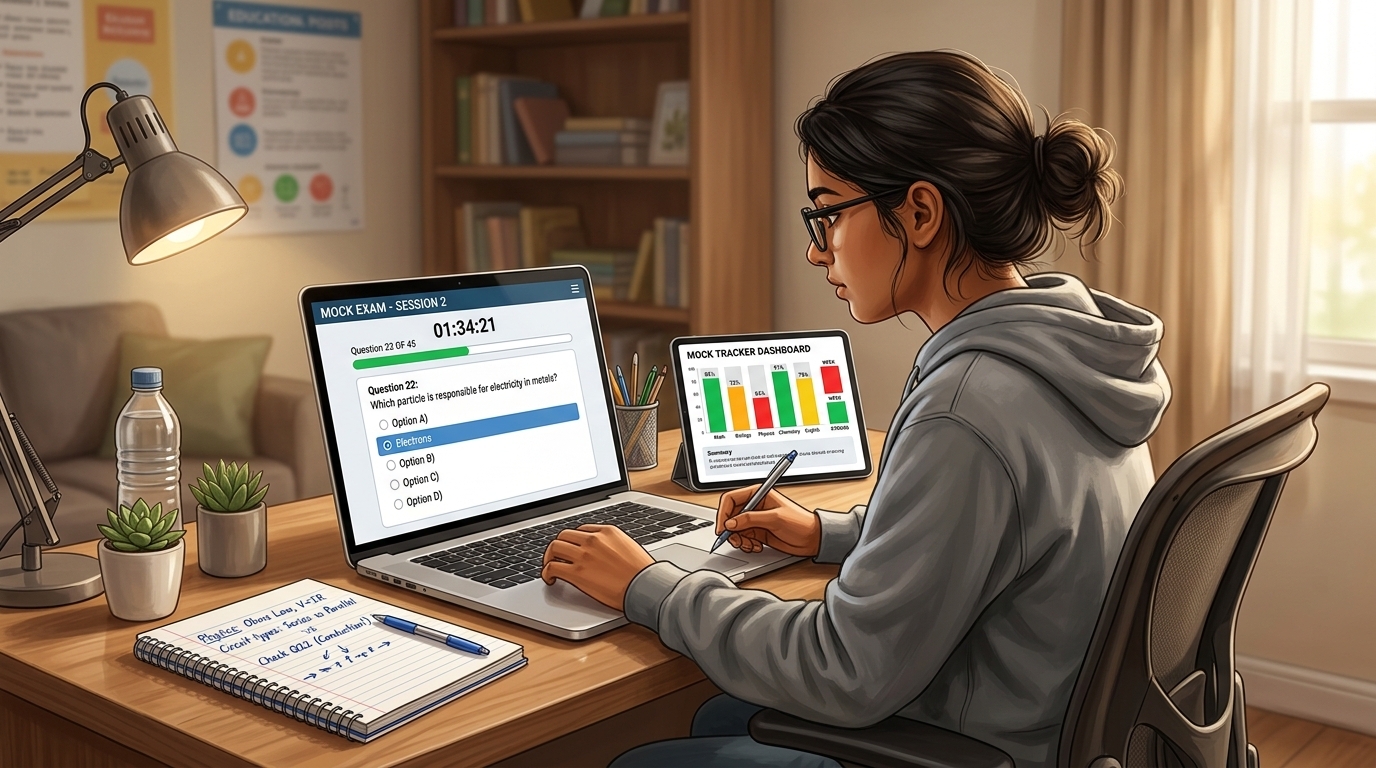
Mock exams: timed, syllabus-mapped, and designed to replicate real exam conditions. Not just a quiz. An actual mock exam environment that shows you where you'd lose marks.
Your own notes: take notes directly inside the platform as you study each topic, so everything you're learning stays connected to the lesson it came from.
Real-time progress tracking: a dashboard that shows, at a glance, which topics are solid and which need work. No guessing. No "I think I'm okay on Chapter 7."
Communities: connect with other students studying the same syllabus, share strategies, ask questions. Because learning doesn't have to be lonely.
This isn't just convenience. Every one of those things represents a friction point where students traditionally lose momentum. Remove the friction, and the studying actually happens.
Deep Understanding vs. Memorisation: The AI Difference
Here's what traditional education never had: a system that could look at your specific pattern of wrong answers and figure out why you're getting them wrong.
A teacher can't analyse 500 individual responses per class period and route each student to their exact gap. An algorithm can and this is where Leminno's AI layer changes the equation entirely.
When you get a question wrong, Leminno doesn't just mark it wrong and move on. The platform uses that data alongside your history on related questions to build a picture of your conceptual understanding. It then surfaces questions that target the exact weak point, not just the same topic. You're not repeating rote answers. You're being pushed toward actual comprehension of why something works the way it does.
That's the difference between a student who can recite the definition of osmosis and a student who can explain why a carrot left in salt water shrivels and then answer the novel application question on Paper 6 they've never seen before.
Deep understanding is built through challenge and feedback. Not through repetition of the familiar.
Why Students Who Use Active Platforms Score Higher
The research on learning science is remarkably consistent: students who engage in active practice outperform passive learners on tests, regardless of prior ability. Not by a small margin by a significant one.
The mechanism is well understood: every time you successfully retrieve a piece of information from memory, you strengthen the neural pathway to it. Every time you receive immediate feedback on a wrong answer, you correct the misconception before it becomes entrenched. Traditional classrooms rarely create these conditions at scale. Digital platforms that run on active retrieval do it by design.
This isn't about tech for tech's sake. It's about the fact that the underlying learning method test yourself, get feedback, adjust is simply more effective than reading and hoping.
The Confidence Problem Nobody Talks About
There's a psychological dimension to this that often gets overlooked: students who don't know where they stand academically tend to either over-study the things they already know (false security) or under-study the things they're weakest at (avoidance). Both are responses to anxiety about the unknown.
Progress tracking seeing clearly which topics are green, which are yellow, and which are red removes that anxiety. When you know exactly what you need to work on, the work feels manageable. When you don't know, the whole subject feels overwhelming and you procrastinate.
This is one of the reasons students who use Leminno's review centre and mistake tracker report feeling more confident going into exams. It's not that they studied more hours. It's that they spent their hours on the right things and could see themselves improving.
Where Do You Start?
If you've been through a traditional classroom and felt like the system wasn't quite working for you you were right. The system wasn't designed for you specifically. But the good news is, you don't have to rely on it.
Head to leminno.com, pick your curriculum (Cambridge IGCSE, A Levels, SAT, and more), and start with a lesson in a topic you already know feels shaky. Do the practice questions. See what the mistake tracker surfaces. Give it 20 minutes.
The difference between passive studying and active learning reveals itself pretty quickly.
Leminno covers Cambridge IGCSE, A Levels, SAT, IELTS and more. Explore curricula →