You revise a topic on Sunday, feel like you've nailed it, and by Wednesday it's gone. That sinking feeling, I literally studied this, is not a sign you're a bad student. It's a sign you revised the way almost everyone is taught to, and that method quietly fights against how memory actually works.
This guide breaks down spaced repetition: what it is, the science behind why it works, and most importantly, a concrete schedule you can start this week for your IGCSE or A-Level subjects. No theory for theory's sake. Just the system we watched outperform every other revision habit while building Leminno's practice engine.
Why cramming feels productive but fails
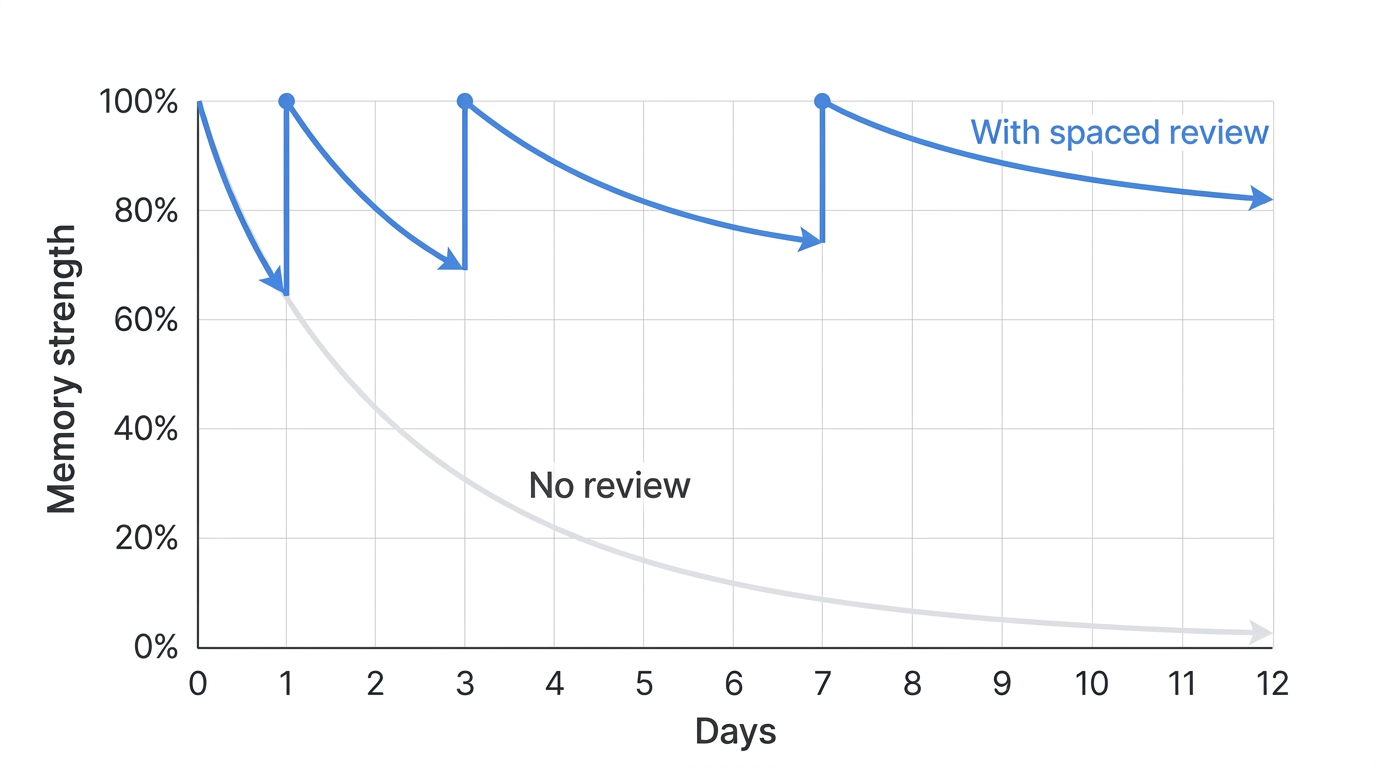
In the 1880s, psychologist Hermann Ebbinghaus measured how quickly he forgot newly learned information. The result, the forgetting curve, is brutal: without review, you lose a large chunk of new material within 24 hours, and most of it within a week.
Cramming loads everything into short-term memory the night before. It can get you through a test the next morning, but it builds almost nothing durable. Two weeks later, at the real exam, the scaffolding has collapsed. For a two-year course like A-Level, where Paper 1 might test something you "learned" eighteen months ago, cramming is close to useless.
The deeper problem is that the activities that feel like studying, re-reading the textbook, highlighting, copying out notes mostly build recognition. You see the page and think "yes, I know this." But the exam doesn't show you the page. It hands you a blank space and asks you to produce the answer from nothing. That's recall, and it's a completely different skill.
Recognition is "I've seen this before." Recall is "I can reconstruct this without help." Exams only ever reward the second one.
The two pillars: active recall + spaced repetition
Spaced repetition works because it combines two of the most evidence-backed ideas in learning science.
Active recall means testing yourself instead of reviewing passively. Cover the answer, try to retrieve it, then check. Every time you successfully pull something out of memory, you strengthen the path back to it. This is sometimes called the testing effect, and it's the single highest-leverage change most students can make.
Spacing means spreading those recall attempts out over time rather than bunching them together. Reviewing a fact five times in one evening helps far less than reviewing it once on five separate days. Each time you revisit material just as it's starting to fade, you reset and extend how long it sticks.
Put them together and you get the core loop: test yourself, on a schedule that stretches as the material gets more secure.
How the review interval should grow
The magic is in the spacing. A card you just learned needs reviewing soon the next day. Once you've recalled it correctly a few times, you can safely wait longer: three days, then a week, then two weeks, then a month. Each correct recall earns a longer gap; each failure sends the item back to short intervals.
Modern scheduling algorithms like FSRS (the Free Spaced Repetition Scheduler, which Leminno's review engine is built on) formalise this. They estimate two things for every item:
- Stability: how long the memory will hold before it needs another review.
- Retrievability: the probability you can recall it right now.
The scheduler's job is to show you each card at the moment retrievability is starting to dip but before it collapses, the point where a successful recall buys you the biggest jump in stability for the least effort. You don't need the maths to benefit from it; you just need to trust the schedule and show up when something is due.
The manual version of this is the Leitner system: a row of boxes for different intervals. Get a card right, it moves up a box (longer interval). Get it wrong, it drops back to Box 1 (daily). It's spaced repetition with shoeboxes, and it works.
A ready-to-use revision schedule
Here's how to actually run this across a typical IGCSE/A-Level subject load. Assume you're starting 8–12 weeks out.
| Week of cycle | What you do | Time per subject |
|---|---|---|
| Weeks 1–2 | Turn each topic into recall prompts as you finish studying it (questions, not summaries) | 20–30 min/day |
| Weeks 3–6 | Daily recall sessions; new prompts enter daily, due ones come back on their interval | 25–40 min/day |
| Weeks 7–10 | Interleave past-paper questions with your scheduled recall; failures reset to short intervals | 40–60 min/day |
| Final 1–2 weeks | Recall only the "weak" pile + full timed past papers | as needed |
A few rules that make the difference:
- Write questions, not notes. "State Newton's second law and give its equation" beats a paragraph re-explaining it. The prompt should force retrieval.
- Do it daily, even if briefly. Twenty consistent minutes beats a three-hour Sunday marathon. Spacing only works if you actually space it.
- Always check, always be honest. If you nearly got it but missed a term, that's a fail. Send it back to a short interval. Lying to yourself here just hides the gaps until exam day.
- Mix subjects in one session. Interleaving Physics, Chemistry and Maths prompts in the same sitting feels harder and that difficulty is exactly what makes the learning stick.
Common mistakes that quietly kill your progress
Making prompts too big. "Explain the whole circulatory system" isn't a recall prompt, it's an essay. Break it into atoms: one fact, one diagram label, one equation per card.
Reviewing too early. If you keep reviewing the same cards every day because it feels safe, you're just cramming in slow motion. Trust the longer intervals, being slightly unsure on review day is where the strengthening happens.
Confusing "I get it" with "I can recall it." Understanding a worked solution and being able to reproduce it cold are different. Always close the book and reproduce.
Neglecting application. Spaced recall locks in the building blocks, definitions, equations, mechanisms. But IGCSE and A-Level papers test applying them under time pressure. That's why the schedule above layers in timed past-paper practice in the later weeks. Recall feeds application; it doesn't replace it.
Where adaptive tools fit in
You can run all of this with paper and a shoebox and if that's what gets you started, do it today. The only thing software adds is removing the admin: it tracks which prompt is due when, adjusts intervals from your actual performance, and points you at your weakest topics first instead of letting you re-revise what you already know.
That's the principle behind the Leminno practice engine: every question you answer updates an estimate of your ability and the difficulty of the item, so the next question lands in your stretch zone, and the spacing schedule reshapes itself around what you keep getting wrong. The point isn't the algorithm — it's that you spend your limited revision hours on the things most likely to cost you marks. You can see the subjects we currently cover and start a diagnostic in a few minutes.
Whichever tool you use, the method is the thing. Test yourself, space it out, be honest about your failures, and start early enough that the spacing has room to work. Do that, and "I literally studied this" stops being a thing that happens to you in the exam hall.