
You revise for weeks, walk into the exam actually knowing the material, and still get your paper back with marks missing next to answers that feel right. It's one of the most demoralising things that can happen to a hard-working student and nine times out of ten, the content wasn't the problem. The command word was.
Command words are the instruction verbs at the start of a question like state, describe, explain, suggest, compare, calculate. Each one is a contract with the examiner about what kind of answer earns marks. Miss the contract and it doesn't matter how much you know you can write a paragraph of correct science and score zero because you answered a different question from the one on the page.
This guide breaks down what each command word actually demands, why "describe" and "explain" are the biggest silent mark-killers, and how to turn any command word into an answer the mark scheme has to reward.
The single most expensive mistake: describing when asked to explain
If you take one thing from this article, take this.
- Describe = say what happens. The features, the steps, the trend on a graph. No reasons.
- Explain = say why it happens. The cause or mechanism. Your answer should almost always contain the word because.
Here's the trap in action. Question: "Explain why the rate of reaction increases when temperature is raised. [3]"
A student writes: "The reaction gets faster and the products form more quickly." Every word is true. It scores zero, because it describes the outcome instead of explaining the cause.
The mark-scheme answer needs the mechanism: particles gain kinetic energy → they move faster and collide more often → more collisions have energy above the activation energy → rate increases. Same knowledge, but now it answers "why."
A good habit: underline the command word before you write a single thing. If it says explain, check that every sentence you write could follow the word "because."
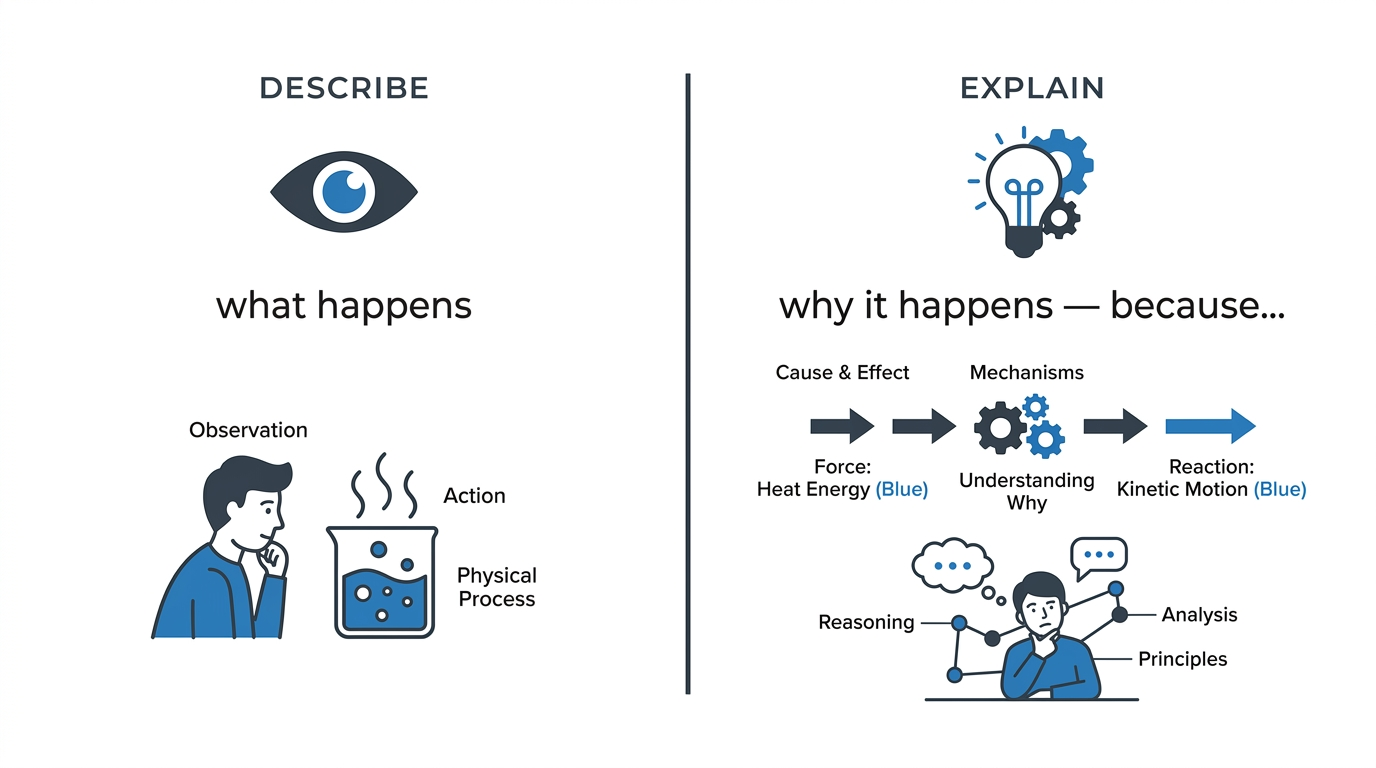 Describe tells the examiner what happens; explain tells them why. Mixing them up is the most common way to lose marks you'd otherwise have earned.
The command-word cheat sheet
Cambridge defines these centrally, so they behave consistently across subjects. Learn what each one is really asking:
| Command word | What the examiner wants | What loses marks |
|---|---|---|
| State / Give / Name / Identify | A short, precise answer. One line. | Over-writing; adding reasons nobody asked for |
| Define | The exact meaning of a term | A vague, "sort of" definition |
| Describe | What happens / the features / the trend | Adding why (wasted) or being too vague |
| Explain | The reason or mechanism because… | Only describing; no causal link |
| Suggest | Apply knowledge to an unfamiliar context | Waiting for a "recalled" answer that isn't there |
| Calculate | A numerical answer with working and units | No working, no units, wrong sig figs |
| Determine | A value worked out from given data or a graph | Guessing instead of using the data |
| Compare | Similarities and differences, linked | Two separate lists that never connect |
| Outline | The main points only, briefly | Excessive detail; running out of time |
Command words tell you how much to write
The command word and the mark allocation together tell you the shape of your answer. This is where students either save or bleed time.
- A 1-mark "state" wants one line. Writing four sentences is a time leak that costs you on the questions that matter.
- A 3-mark "describe" wants three distinct, creditworthy points not one point explained three ways. Examiners tick separate ideas.
- "Compare" almost always needs linked statements: "X is faster than Y, whereas Y is more accurate." Two unlinked lists usually only score half.
The reliable rule: count the marks, then plan that many distinct points before you write. It sounds mechanical because it is and it's exactly what turns known content into scored content.
"Suggest" is not a memory question
"Suggest" catches out even strong students because they sit there trying to recall an answer that was never taught. That's the point of the word: the examiner has deliberately put you in an unfamiliar scenario to see if you can apply your knowledge.
There's often no single correct response. A sensible, scientifically reasoned answer scores even if it's not the one the examiner had in mind. So when you see "suggest," stop hunting your memory and start reasoning from principles you do know.
How to actually build this into a reliable habit
Knowing the command words isn't the same as using them under time pressure. The fix is deliberate practice on real questions:
- Before answering, circle the command word and note the marks.: Every question. It takes two seconds and reframes your whole answer.
- Practise with the mark scheme open.: After each answer, check why the scheme awarded each mark. You'll start to see the pattern in what earns credit.
- Keep a "lost marks" log.: Every time you drop a mark, write whether it was content or command-word. Most students are shocked how often it's the second and that's fixable fast.
- Drill the confusable pairs: describe/explain, compare/contrast, state/define until the distinction is automatic.
This is where structured past-paper practice earns its keep: you're not just checking if you knew the fact, you're training yourself to answer the exact question asked. Pair it with a spaced-repetition schedule for the underlying content and you close both gaps at once you know the material and you deliver it in the form the mark scheme rewards. You can start a diagnostic on your subject in a few minutes.
The content in your head is only worth the marks you can extract from it. Command words are the extraction tool. Learn them, and you stop being the student who "knew it all" but somehow didn't get the grade.